 EN

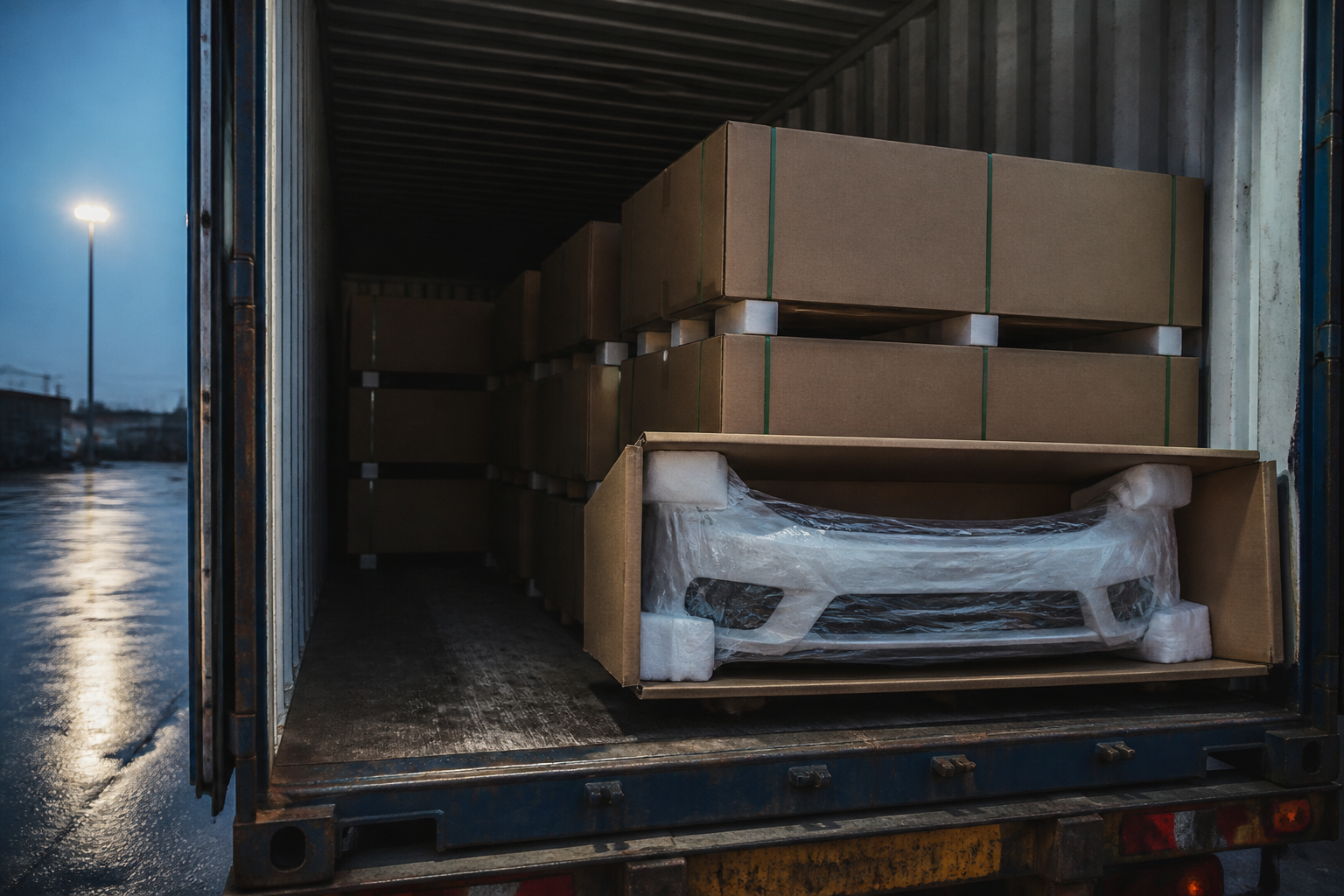
A painted bumper is a big, flat, expensive piece of plastic that has to sit in a steel box for three weeks while the ship rolls around in the ocean. Headlight assemblies add glass, electronics, and a lens that cannot take a scratch. Export packaging is the cheapest insurance in the whole supply chain, and it is the step most damage claims trace back to. After 17 years of shipping exterior parts from China, here is how we pack, load, and document a container so it arrives the way it left.
Why Body Parts Get Damaged in Transit
Most transit damage is not dramatic. There is usually no broken seal and no missing carton. What happens is quieter: a container is a pendulum. On a rough crossing, cargo that can slide even a few centimeters gets hit by the cargo in front of it, over and over, for days. One shift per wave cycle, thousands of times, is enough to crack a lamp housing or scuff a fresh paint surface.
The part shapes make it worse. Hoods and fenders are long, thin, and slightly curved — lay one flat on top of another and the middle sags, which is how you get a warped panel that will never fit flush. Bumpers have deep corners and integrated trim that catch on anything. Grilles are mostly open mesh, so they dent where you would least expect.
And the environment inside a container is not neutral. Temperature swings condense moisture on cold surfaces, humidity creeps into any lamp that is not sealed against it, and dust from cardboard and dunnage settles on every painted face. Packing decisions that look cosmetic at the loading dock become claims at the unloading dock.
Packing by Part Type
Different parts need different treatment, and the rule that covers most of it is: the painted or optical surface never touches anything, and nothing heavy ever sits on a panel.
Bumpers. Wrap the front in PE foam, add hard corner protectors on the deep edges, and slip the whole unit in a poly bag so cardboard dust stays off the paint. Two bumpers can share a carton only if a full foam layer separates them, and they stack vertically, never face to face.
Headlights and tail lamps. Double-box them: inner box with molded or cut foam around the lens and housing, outer box for the stack. The lens side always faces up. Any unit with canbus electronics or a moisture-sensitive connector gets a sealed bag with desiccant — humidity in transit is the quiet killer of lamp boards.
Hoods and long fenders. These need a cradle, not a shelf. Foam supports under the middle and the ends keep a long panel from bowing. A hood packed flat on flat board for 30 days will arrive with a crown in it. Fenders get edge wrap on the exposed trim line and a foam block between every pair.
Grilles and radiators. Box with cross-foam so the mesh cannot be crushed by the stack above. A radiator is the one part that also needs orientation control — it always travels upright or on its back, never on its core, and every carton carrying one gets marked "THIS SIDE UP" and "FRAGILE - COOLING CORE".
The packing cost of doing this properly is a small percentage of the part. The cost of a single returned, repainted, re-boxed bumper is usually several times the container's worth of foam.
The Container Side: Loading, Bracing, and Air
A perfect carton inside a sloping container is still going to move, so the second half of the job is the load plan. Load heaviest at the rear wall, keep the weight low and even, and block every vertical face of every stack with dunnage so nothing can walk during a turn. Straps go over the top of the tallest stack, tight enough that the load sits as one piece. A container that rocks when you push on the door is a container that will file a claim.
Two habits matter more than the rest. First, plan the quantity: a 40-foot high cube carries a predictable number of bumper cartons, and loading to the plan — not "until it looks full" — is what keeps the last row from becoming the first casualty. Second, manage the air. Desiccant in every lamp bag, and for any container with mixed cargo, a ventilated space at the top where warm, moist air can collect instead of settling on the painted faces.
For the bigger picture of how a container moves from factory floor to buyer's dock — inspection points, documentation, and the milestones where problems surface — our auto body parts export guide walks through the full route.
The Paper Trail That Prevents Claims
Packaging wins the argument before the container is sealed, but the paperwork is what actually settles it. Before the door closes, photograph every stack in the container — door side, rear wall, and the top of each load — with the carton labels visible. At the destination, photograph the same positions before anything is unpacked, and open cartons in the presence of the freight forwarder if anything looks moved.
The packing list does quiet work here. When it lists part numbers and counts per carton — not just "24 pcs bumper" but which model in which carton — a short count or a wrong unit is found in five minutes instead of five days. Cartons get marked with the model, the part count, and the orientation arrows, because the crew that unloads your container will never meet the crew that loaded it.
None of this is exotic. It is the same checklist we run before every container we ship, and it is part of the quality system behind our company certification. If you want the packaging spec for a specific part line — foam types, carton sizes, container load plan — contact KEBEL and we will send it with the quote.
FAQ
How should painted bumpers be packed for container export?
PE foam wrap on the front, hard corner protectors on the deep edges, a poly bag to keep dust off the paint, and vertical stacking with a full foam layer between units. The painted surface should not touch cardboard, foam dust, or another bumper at any point in the stack.
Do headlight and tail lamp assemblies need special treatment?
Yes, two things: double-boxing with the lens side up, and a sealed bag with desiccant around any unit with electronics. Humidity and condensation inside a container are what damage lamp boards, not the physical handling.
What should I photograph before the container is sealed?
Every stack from two positions — the door side and the rear wall — with carton labels readable in frame. Then photograph the same positions on arrival, before unpacking. That pair of sets is what turns a "the carton looks moved" argument into a five-minute claim.